

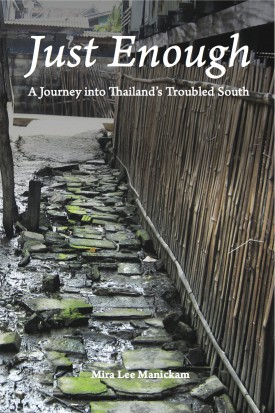
Fishing for Happiness, Published by Sage Magazine, 2012, as winner of the 2012 Young Environmental Writer’s contest.
To read in the Online Magazine, click here
It is daybreak in the southernmost tip of Thailand, and Pattani Bay is smooth as a lake, reflecting the purple and orange which streak across the sky announcing the sun. I am accompanying Abdulla, a local fisherman, as he draws up the crab nets he has placed the night before. Every morning after his pre-dawn prayer, Abdulla sets out from the shores of the small fishing village where he lives and spends about three hours in his boat pulling up 800 meters of net. Standing at the bow in his canvas hat and sweat pants, he works alone, sometimes humming as he pulls up the long strips of mesh, which sparkle as the water slides off them in the soft morning sun. When he encounters an entangled crab, he tosses that section of net to the stern of the boat where I am sitting. The catch comes in slowly, with about one crab per thirty meters of net, but the net is long. By the end of three hours about thirty crabs and a dozen or so fish of low value lay piled at my feet.
When the last net is pulled we return to shore and Abdulla’s mother, a lively lady with a warm round face, greets us. She comes to inspect the catch and immediately begins detangling the crabs, a process that will take the next hour or so. Abdulla will not let me leave without taking some, so try as I might to refuse, I depart with a small plastic bag of blue crab fresh from the sea. The catch that day is poorer than usual. Accounting for the price of gasoline, Abdulla will make a profit of about $4 –– on a good day it could be as much as $10 but usually it’s somewhere around $6. By the end of most days the money will be finished, but it may be just enough to cover daily food expenses, tea, cigarettes, and school fees for his kids.
Abdulla’s livelihood is typical of the thousands of fishermen living off the fragile estuarine ecosystem of Pattani Bay and many other small-scale fishermen throughout Thailand. Living on tight margins and relying on natural resources which are becoming increasingly scarce, he stands outside what has become the dominant narrative of modern Thailand –– a remarkable story of rapid economic progress. He also stands inside one of Thailand’s most troubled regions.
***
The Southern Three Provinces of Thailand, where Abdulla lives, are locked in an insurgency that rarely makes it into the news in America, but has claimed over 3,500 lives. Unlike the rest of the mostly Buddhist country, the Southern Three Provinces are predominantly Muslim, and local people speak a Malay dialect, which is written in Arabic script. Since their incorporation into the country in 1903, they have had a tumultuous relationship with the central Thai state, which has promoted a Buddhist-centered nationalism. In 2004, insurgent sentiments erupted in a series of raids on police and army outposts, and since then the violence has escalated steadily. Identifying the perpetrators has been difficult, and government policies have divided rather than healed, as heavy-handed military and police actions have vilified and oppressed the local Malay-speaking Muslim people rather than assisted them. Long-held cultural prejudices among the Thai Buddhist mainstream about Malay-speaking Muslims –– whom they perceive as under-developed, undereducated, and lazy –– only exacerbate the situation. By the time I first reached the region in the summer of 2006, it was considered by most Thais to be a very dangerous place.
I came to Dato, the small fishing village where Abdulla lives, not as a student of this conflict but as a student of the natural environment. After working in Thailand for two years on water and forest management, I was concerned with the wrenching changes facing rural communities that had traditionally depended on agricultural or fishing livelihoods but were finding it more and more difficult to make a living. The six dollars to be earned per day by fishing is meager when compared to the rising incomes of Thailand’s growing middle class, and small-scale fishing operations like Abdulla’s can seem less and less attractive by comparison.
At the same time, nearly everyone in the country –– on all sides of the political spectrum –– was touting the merits of something called in Thai setakit paw piang, which translates literally into the “sufficient” or “just enough” economy. Government-sponsored television ad campaigns, featuring soft-focus images of smiling children donning homespun clothes in emerald green landscapes, espouse the beauty of a simple rural life removed from material consumption and western excess. However, given the limited extent to which these values were embraced by the credit card-wielding, gadget-hungry Thai middle class, including those who conceived this campaign, I wondered if perhaps these ads were aimed mostly at convincing those who couldn’t join the country’s economic growth parade to be happy with the poverty they got in exchange.
My contacts at the Prince of Songkhla University, forty-five minutes away, directed me to Dato. I was studying rural environmental activism, and I wanted to learn how Dato’s small-scale fishermen, who lived far from the halls of power, had come to challenge commercial interests and government development schemes that threatened the bay where they lived. The people of Dato, in partnership with the local university, had planted large stretches of mangrove forests along their shores, started a youth conservation club, and led the efforts for policy reform regarding natural resource management in Pattani Bay. I also hoped that spending a summer in the Southern Three Provinces would help me penetrate the dense fog of misunderstanding surrounding the conservative Islamic culture for which the region was known. As I soon learned, only by getting to know this culture would I begin to find the answers to my question.
 Mira Manickam